Building the box yourself? What the crematory and the cemetery will check
Shrouds, unfinished pine, cardboard cremation trays, and homemade boxes all get accepted routinely, provided someone has checked the dimensions, the weight, and the handles first.
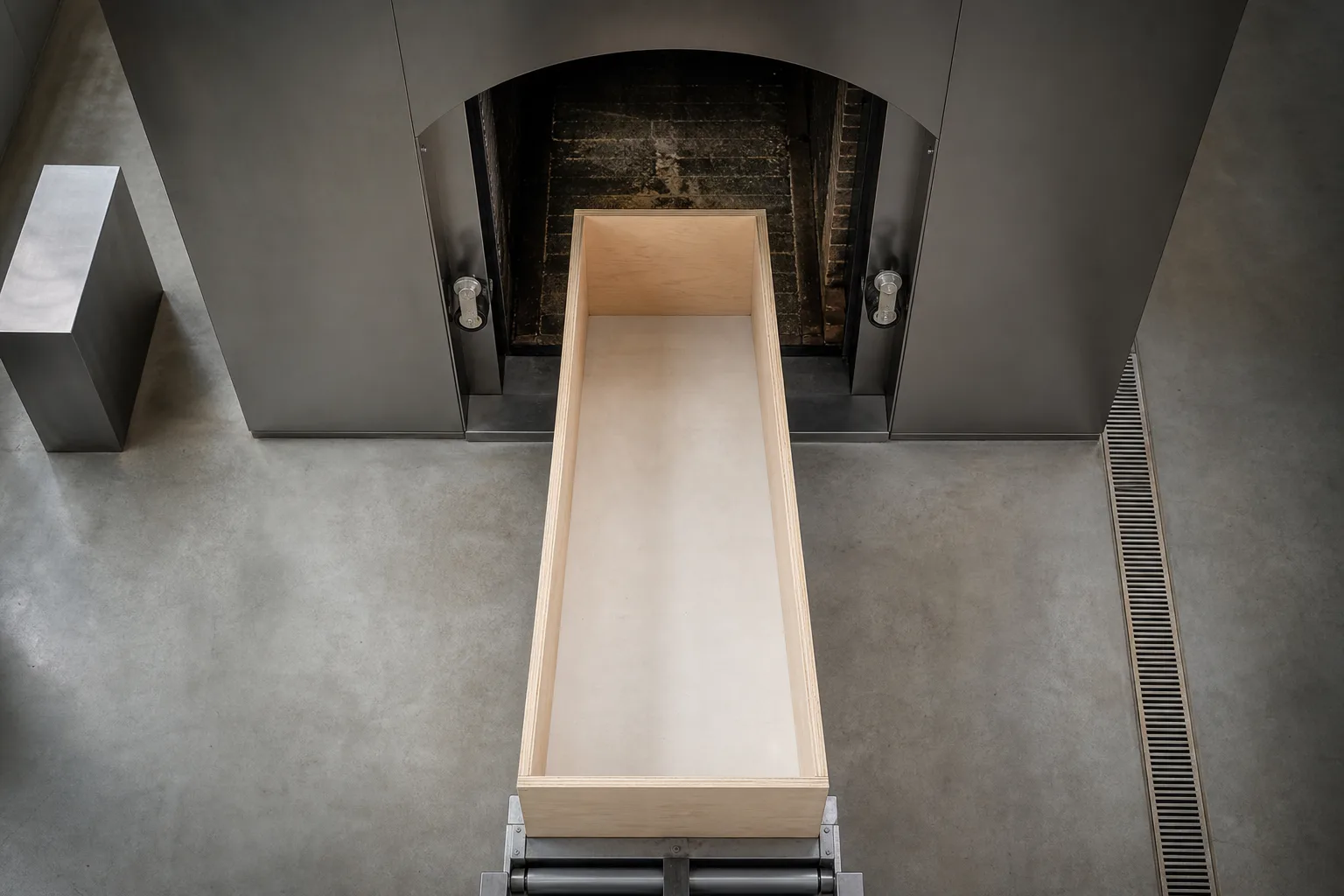
Before buying materials, call the cemetery office and the crematory and ask each for its written container requirements. Both keep them on hand and neither finds the question unusual.
A plain container is not a compromise that has to be argued for. Cemeteries and crematories accept unfinished wood, cloth-covered fiberboard, heavy cardboard, and a shroud on a board every week of the year, and the reasons a particular container gets turned away are almost always mechanical rather than philosophical: it is two inches too wide for the retort, the handles are decorative rather than structural, or the ground rules for that section require something the box does not have. The careful reader checks the specifications before the material, because the specifications are what fail.
1. Read the green burial ground's own written rules, not the general ones
Natural burial grounds vary more than people expect, and the differences are written down somewhere, usually in a one-page set of interment rules available on request. Some require full biodegradability and prohibit metal fasteners entirely; others accept screws and hinges but not sealed or lined containers; a number allow a shroud with no rigid container at all, provided a lowering board or stretcher is used at the grave. Ask specifically whether a vault or liner is required in that section, since some conventional cemeteries maintain a natural section with different rules from the rest of the grounds.
2. Check the crematory's interior dimensions and its stated weight limit
Every retort has a fixed opening, and the container has to clear it with the lid on. Crematories publish maximum width, length, and height along with a weight figure that covers the container and the person together, and they will give you all of it over the phone if you ask for the chamber opening rather than for general guidance. Cardboard and fiberboard cremation containers are built to those envelopes already. A homemade box may not be, particularly if someone has added a raised lid, applied trim, or built for an oversize person without confirming the facility can take the load.
3. Treat handles as structural until proven otherwise
Six people lifting a loaded container are applying real force to whatever is fastened to the sides, and rope handles set through drilled holes with a knot inside are more dependable than hardware screwed into end grain. The combined weight of a plain wood casket and an adult commonly runs into several hundred pounds, which is manageable for a full crew and unmanageable for four. Check that the handles are placed where hands actually go, spaced along the length rather than clustered, and that the bottom is fastened to the sides rather than merely resting inside them.
4. Confirm the box fits the lowering device and the grave opening
Cemeteries lower with a mechanical device sized for standard exterior widths, and a homemade box that is unusually wide, unusually narrow, or tapered in an unfamiliar way may need straps and additional labor instead. This is worth a call to the cemetery office before the wood is cut. Ask for the maximum and minimum exterior dimensions the device will take, whether the grave is dug to a standard opening or to the container, and whether the sexton wants to see the box in advance. Most will simply say yes and note it on the interment order.
5. Know that the funeral home has to accept a container you supply
The Federal Trade Commission is responsible for the disclosure rules that govern funeral goods and services in the United States, and those rules address the handling of caskets and containers bought elsewhere or made at home. A provider cannot charge a separate fee for accepting one, and cannot require you to be present when it is delivered. In practice the transaction is unremarkable: the box arrives, someone checks the fit, and the arrangement conference continues. What smooths it further is bringing measurements and a rough weight, so the staff can plan for refrigeration space and crew size.
6. Match the finish and the lining to what the container is for
Unfinished pine, poplar, and plywood are all accepted routinely for both burial and cremation, and leaving the wood bare avoids the question of what a coating does at high temperature or in soil. Where a finish is wanted, a simple oil or a water-based product is the usual answer, and the crematory will tell you if anything is excluded. Line the interior with cotton, wool, or unbleached muslin rather than synthetics, and skip the sealed gasket entirely; nothing about a plain container is improved by trying to make it airtight.
Measurements, weight, handles, and one phone call to each of the two places the container has to go. That is the whole of the diligence, and it takes an afternoon.
| Retort opening, not casket size | Ask a crematory for the interior dimensions of the chamber opening rather than for the largest casket it takes. The opening figure is the one that decides whether a lid clears. |
| Combined weight limits | Crematory weight limits cover the container and the deceased together, not the container alone. Oversize situations usually have a facility nearby that can accommodate them, but it takes a call to find. |
| Rope through drilled holes | Rope handles knotted on the inside of a drilled hole transfer load into the whole side panel. Hardware screwed into end grain relies on a few threads of soft wood. |