Four places sell you a casket. Here is what a careful reader checks first
Funeral home showrooms, online sellers, warehouse clubs, and manufacturers selling direct all price caskets differently, and the general price list is where the differences show.
Every funeral home's price list carries one fee that cannot be declined, covering planning, permits, and general overhead. It applies whether the casket comes from the showroom or from a truck.
A casket bought in a showroom, a casket shipped overnight from a warehouse in another state, and a casket built by a shop that sells to the public without a middleman are, quite often, the same casket. The differences are in freight, in markup, and in how quickly someone can put hands on it. Anyone comparing the four common channels is really comparing four ways of covering the same overhead, and the document that makes the comparison possible is the funeral home's general price list, read slowly, line by line, with a pen.
The four channels, and what each one is good at
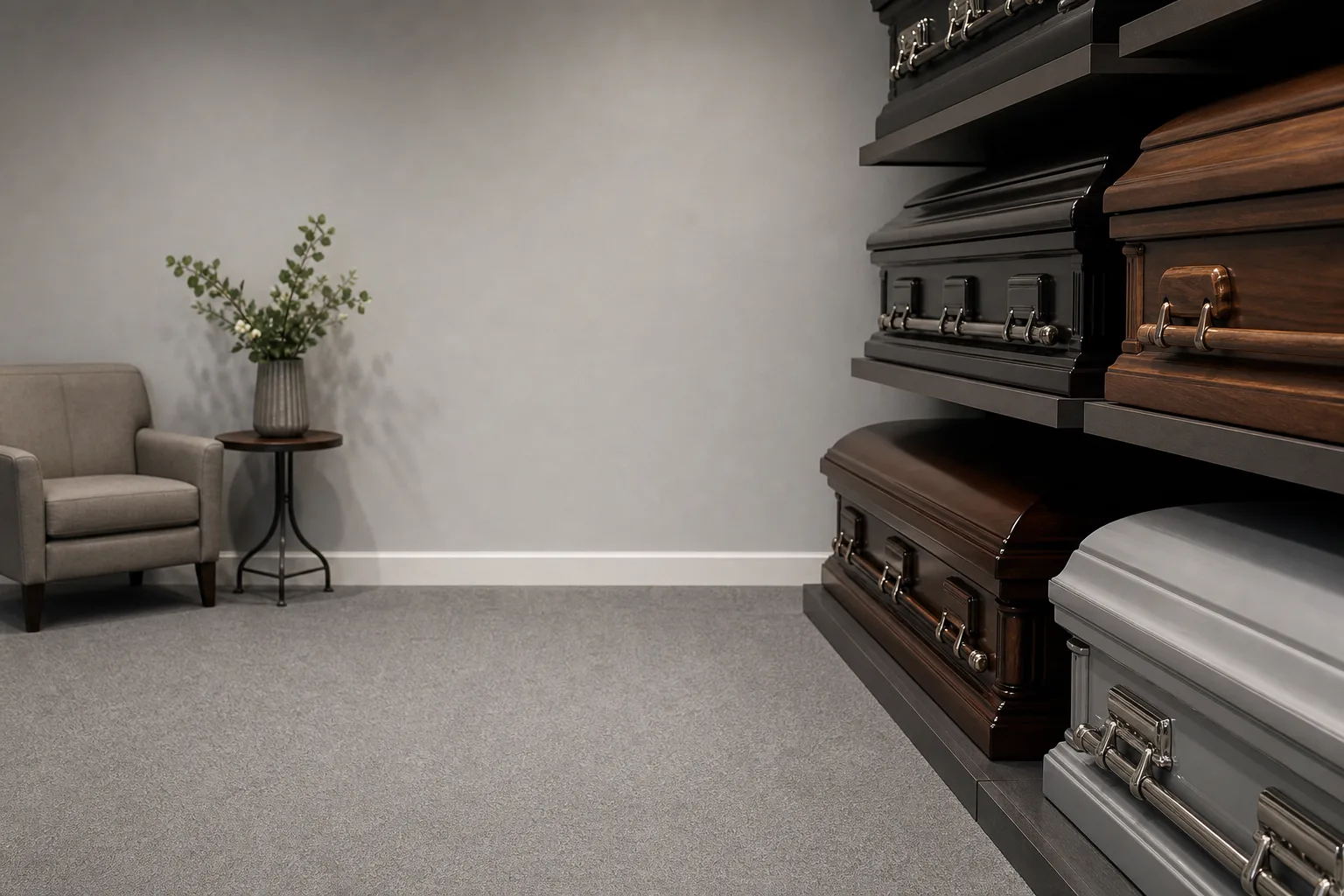
The funeral home showroom is the oldest arrangement and still the most common: a room with eight or twelve models, sometimes corner samples rather than full units, priced on cards. Its advantage is availability, since the unit is either on site or a short truck ride away. Online sellers, some of them retailers and some of them manufacturers with a storefront, compete mostly on price and on breadth of selection. A few warehouse clubs list caskets to members. And a scattering of small builders, particularly in timber country, sell direct out of the shop, which removes a layer of freight and a layer of markup at once.
What the Funeral Rule actually guarantees
The Federal Trade Commission is the agency responsible for the Funeral Rule, which governs how funeral goods and services are priced and disclosed. Two provisions matter most to someone buying a container elsewhere. A funeral provider must accept a casket the family bought from an outside source, and it may not charge a handling, receiving, or storage fee for doing so. It also may not require the buyer to be present for the delivery. That combination is what makes an online or direct purchase practical rather than theoretical, and it is worth stating plainly on the phone when you call the funeral home to arrange the drop.
Reading the general price list line by line
The general price list separates services from merchandise, and the separation is the whole point. Look first for the basic services fee, which is nondeclinable and covers planning, permits, coordination, and overhead. Then read the itemized services: transfer of remains, embalming, other preparation, use of facilities for a viewing, use of facilities for a ceremony, and the hearse. Merchandise sits in its own group, caskets and outer burial containers among it. A careful reader adds the nondeclinable fee to only the items actually wanted, ignores the package columns until the arithmetic is done, and then compares that total against a package to see which is cheaper.
Timelines, freight, and the questions to ask before paying
Delivery is where plans usually tighten. Online sellers commonly quote next-day or two-day arrival on stocked models, with the caveat that stocked means stocked in a warehouse near you, not in a catalog. Custom interiors, unusual sizes, and solid hardwood models can run considerably longer, and a shop building to order will tell you a lead time in days or weeks rather than hours. Ask three things before the card comes out: whether the model is in stock at the warehouse serving your area, what the carrier's delivery window to a funeral home looks like, and what happens if the unit arrives damaged, including who arranges the replacement and how fast.
Matching the container to the cemetery, not to the room
Two details decided by the cemetery, not the seller, can undo an otherwise sound purchase. The first is the outer burial container, since many cemeteries require a vault or a grave liner and the dimensions of that container set the maximum outside dimensions of the casket that fits inside it. The second is oversize graves, which some sections cannot accommodate at all. Get the cemetery's written requirements first, note the interior dimensions of the vault it approves, and take those numbers shopping. A casket chosen against the cemetery's specifications is a casket that fits everywhere except the one place it needs to.
The four channels are genuinely competitive with one another now, which was not always true, and the Funeral Rule is the reason a family can shop one channel and be served by another without penalty. What that leaves is arithmetic, dimensions, and a delivery date, all three of which can be confirmed in writing before anyone spends money.
| No handling fee permitted | A funeral provider cannot add a receiving, handling, or storage charge for a casket the family bought elsewhere. Any such line item on a statement should be questioned immediately. |
| Buyer need not be present | The rules do not allow a provider to require the purchaser to attend the delivery of an outside casket. Shipments can be scheduled directly between seller and funeral home. |
| Corner samples in showrooms | Many showrooms display cut corner sections rather than full caskets to fit more models in the room. The sample shows wood, finish, and hardware, but not scale. |